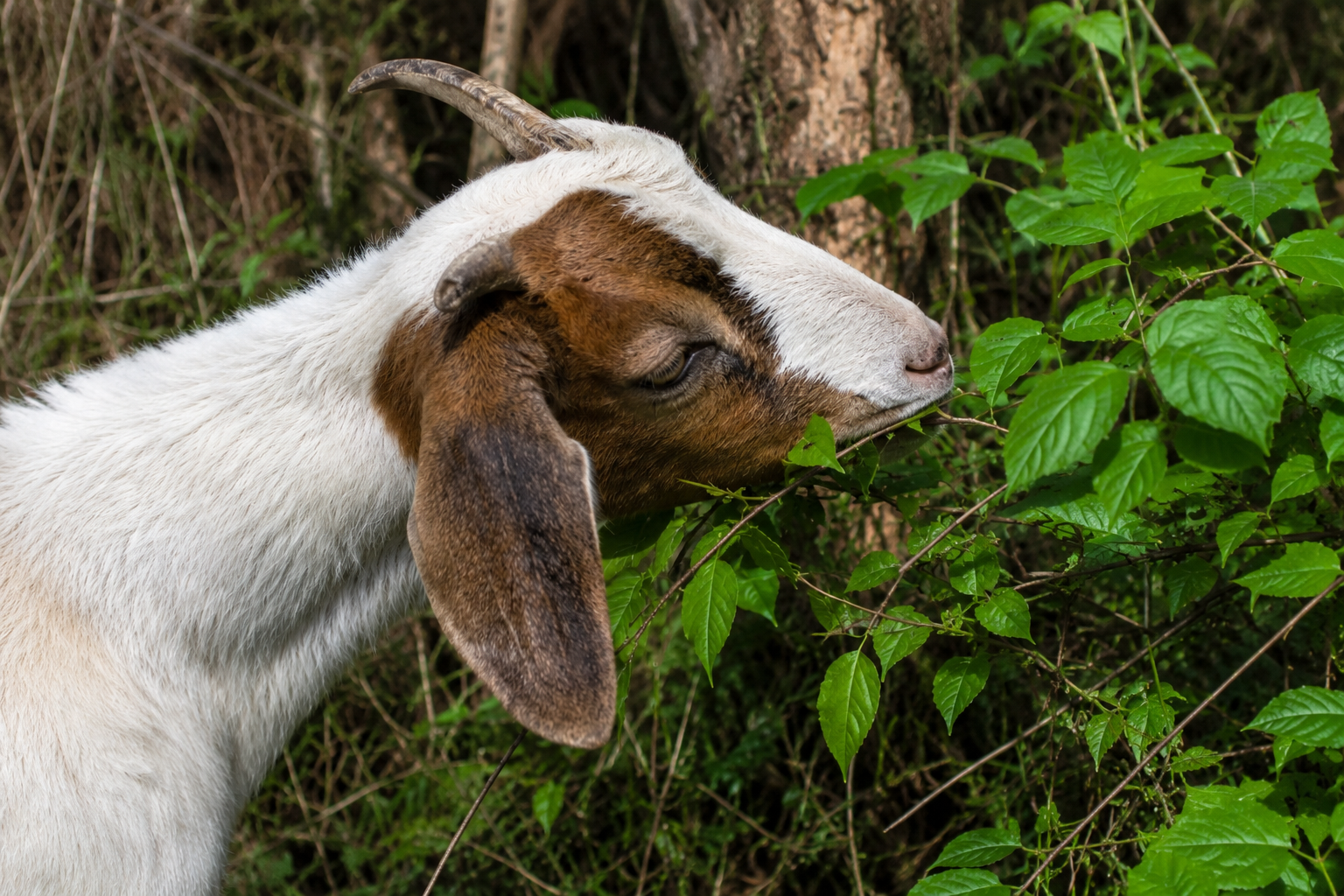
If you've spent any time researching poison ivy removal, you've probably come across the idea of using goats. There are goat rental companies that specialize in it, YouTube videos showing goats happily munching through entire hillsides of the stuff, and plenty of homeowners who swear it's the natural, chemical-free answer. On the surface, it sounds perfect. Goats are immune to urushiol, they'll eat almost anything, and watching them clear a patch of woods is genuinely satisfying to watch.

But if your goal is actually getting rid of poison ivy, not just temporarily knocking it back, goats fall short in some important ways. Here's what the goat rental companies usually don't tell you.
Goats Eat the Leaves, Not the Roots
Poison ivy doesn't spread through seeds alone. It spreads aggressively through an underground root and rhizome system, and that root system is exactly what allows the plant to come back again and again no matter how many times the top growth gets removed.
Goats browse. They eat leaves, stems, and vines above the ground. They are not digging up root systems. Once they've grazed an area, the poison ivy roots are still very much alive underneath the soil, storing energy and ready to send up new growth within weeks. You'll get a temporary clearing, not an eradication.
Goats Poop Out Viable Seeds
This is the part that surprises most people. Goats are ruminants with a digestive system built to process tough plant material, but that system doesn't destroy every seed that passes through it. Poison ivy berries contain seeds that can survive digestion and come out the other end still capable of germinating.
That means a goat can eat poison ivy in one part of your property and then deposit viable seeds somewhere else entirely, whether that's a different corner of your yard, a neighboring pasture, or wherever else they graze next. Instead of removing poison ivy from your land, you can end up planting it in new locations without realizing it.
Goats Don't Discriminate
Goats are famous for eating almost anything, and that's a feature when you want brush cleared, but it's a serious drawback when you have plants you actually want to keep. Goats will just as happily strip the bark off young trees, eat your perennials, mow down berry bushes, and damage ornamental plantings while they're going after the poison ivy mixed in around them.
If poison ivy is growing through or near landscaping you care about, goats aren't a targeted tool. They're a blunt one. You may end up trading a poison ivy problem for a "why is my garden gone" problem.
Rented Goats Can Spread the Problem Between Properties
Goat rental services are popular precisely because most people don't want to own goats full time just to handle a patch of poison ivy. But rental goats work multiple properties, often in the same general area, over the course of a season.
Since poison ivy seeds can survive digestion, a rented herd that grazes an infested property one week can carry viable seeds to the next property they're brought to, whether that property had poison ivy before or not. It's a plausible way for poison ivy to hitch a ride between yards, which is the opposite of what anyone hiring goats is trying to accomplish.
So What Actually Works?
Getting rid of poison ivy for good means dealing with the root system, not just the visible vines and leaves. That generally means a combination of:
- Careful physical removal that includes digging out roots and rhizomes, done with proper protective gear
- Targeted herbicide application directly to cut stems or foliage, rather than broad spraying
- Repeated follow-up treatments over a season or more, since poison ivy rarely dies after a single removal effort
- Proper disposal, since burning poison ivy releases urushiol into the air and cutting it loose without bagging it just relocates the problem
It's slower and less photogenic than turning a herd of goats loose on a hillside, but it's the difference between managing poison ivy and actually eliminating it.
The Bottom Line
Goats aren't useless around poison ivy. If you need fast, temporary knockdown of dense growth in an area with nothing else worth protecting, they can be a reasonable first step. But they are not a long-term or complete solution. The roots stay behind, the seeds can come out the other end still viable, your other plants are at risk, and rented goats can carry the problem from property to property.
If your real goal is a yard that's actually free of poison ivy, not just temporarily thinner, the work has to happen at the root level, literally.
Comments
Loading comments…