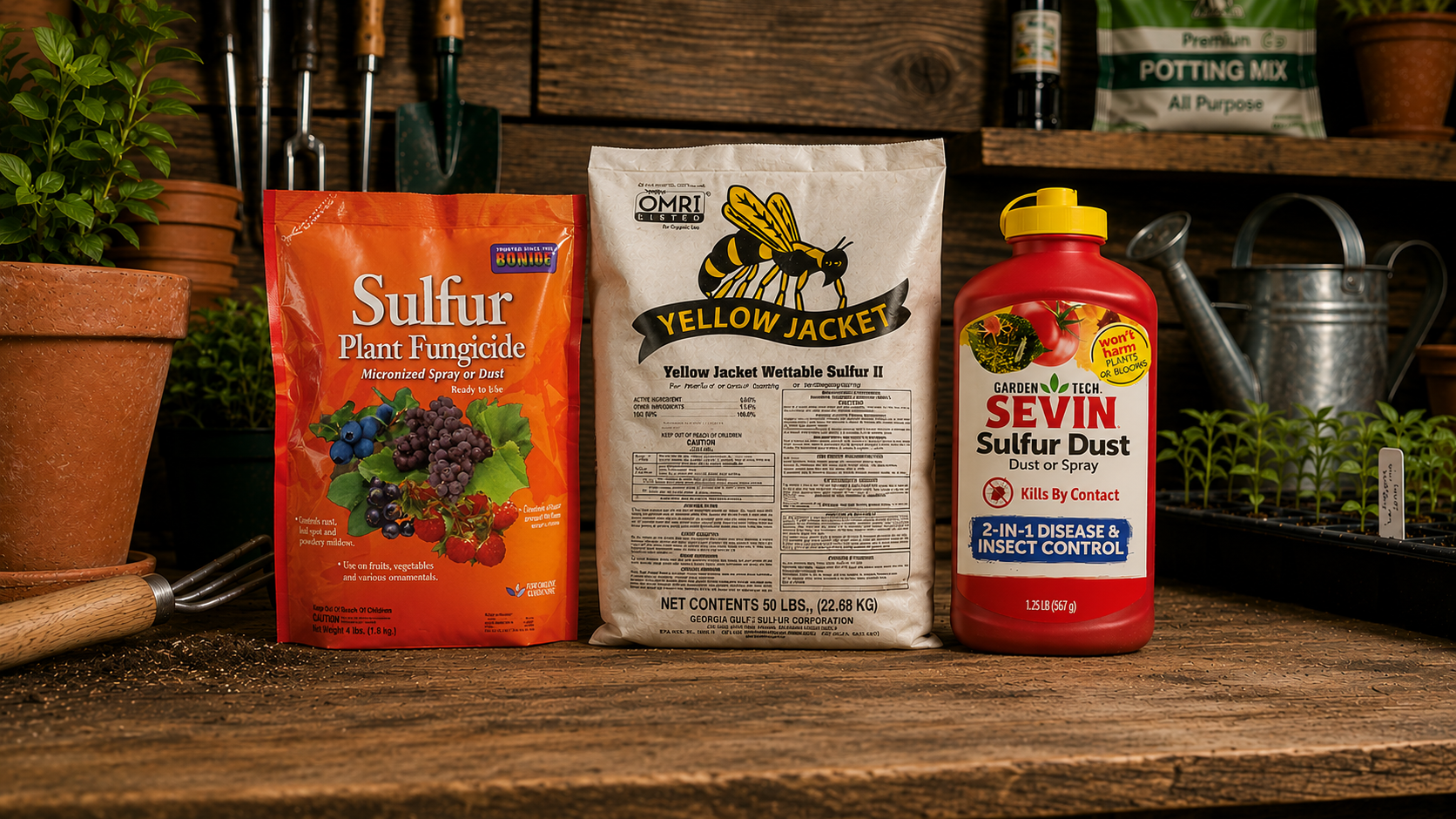
Every fungicide on the garden center shelf claims it will save your plants. The truth is, none of them are interchangeable. Grab the wrong one and you're either wasting money, stressing a plant that didn't need it, or spraying something that was never going to touch the disease you're actually fighting.
Instead of listing off products, I want to walk through the five real categories of fungicides, what each one is built for, and how to figure out which one belongs in your hand before you head out to the garden. I go through all of this in detail in the video below, bottles and all.
Watch the full breakdown here: 5 Types of Fungicides Every Gardener Needs to Know
Start With Two Questions
Before you even think about which product to grab, ask yourself two things.
Is the disease already established, or am I trying to stop it before it starts? Most fungicides are preventative. They're a barrier that has to be in place before the infection takes hold. Spraying a preventative fungicide on a plant that's already covered in blight is a lot like putting on a raincoat after you're already soaked. There's exactly one category below that has real curative power once an infection is underway.
Is this actually a fungus, or is it bacteria? Most backyard problems are fungal, but fire blight, bacterial spot, and bacterial canker are bacterial, and the majority of fungicides won't do a thing against them. Only one type on this list handles both.
Type 1: Copper Fungicides
Copper, usually as copper octanoate or copper sulfate, is the one product on this list that fights fungus and bacteria at the same time. That makes it the answer when you're staring at a plant and genuinely can't tell what you're dealing with, or when you know it's bacterial, like fire blight or peach leaf curl.
It's also one of the oldest fungicides in existence, tracing back to the Bordeaux mixture French vineyard growers were using in the 1800s.
The catch: copper is a metal, and it accumulates in soil over years of repeated use. If you're reaching for it every season on the same bed, you're slowly building up a heavy metal load that doesn't break down. That's a real cost to weigh against the benefit, especially if your actual problem is something gentler options could have handled, like powdery mildew.
Type 2: Chlorothalonil Fungicides
This is the synthetic workhorse, and it's the longest-lasting contact barrier on the list. Once it dries on the leaf, it holds up longer between applications than the other options, which matters if you're dealing with aggressive early or late blight on tomatoes and potatoes and don't want to be out there every four or five days.
It's not organic-approved, it carries a skin irritation risk that means gloves and eye protection, and it has use restrictions around schools, daycares, and playgrounds. If you're growing organic, or you've got kids and pets constantly in the garden, this probably isn't your first reach.
Type 3: Sulfur Fungicides
If you're seeing that white, dusty coating on squash, cucumbers, or zinnias, sulfur is the classic answer for powdery mildew. It may be the oldest disease control substance humans have ever used, with records going back to ancient Greece.
It's organic-approved and safe right up to harvest day, but it comes with two rules that aren't optional. Never spray above 85 degrees, since it will burn foliage in the heat. And never combine it with an oil spray, or apply it within two weeks of one, since that combination will scorch the plant. Certain plants, like Concord grapes and apricots, can't tolerate sulfur at all, so check before you spray.
Handled correctly, this is probably the gentlest of the true chemical fungicides. No soil buildup like copper, no synthetic chemistry like chlorothalonil or the systemics.
Type 4: Systemic Fungicides
Systemics like myclobutanil are the exception to the "preventative only" rule. Instead of sitting on the leaf surface, they get absorbed into the plant tissue, which means they protect new growth that forms after you spray, and they can knock back a light, already-established infection instead of just blocking what's coming.
They're also rainproof once dry, and a single application can protect for up to two weeks, the longest window on this list. The tradeoff is that this is the most aggressive category here. Products in this class often carry a California Prop 65 warning for reproductive harm, and they're not organic. Leaning on the same systemic every single spray cycle also raises the risk of the pathogen developing resistance to it.
Type 5: Biofungicides
These aren't chemicals at all. They're living beneficial bacteria, and the way they work is genuinely different from everything else on this list. Rather than just sitting on the leaf and blocking pathogens out, they trigger the plant's own immune response, so the plant is defending itself on top of whatever the bacteria is doing directly.
This is the gentlest option available, organic-approved, and safe to spray the day of harvest. The downside is that it won't bail you out of an infection that's already tearing through a plant. This is a prevention and light-pressure tool, not a rescue tool, which also makes it a great rotation partner to keep your other fungicides working longer.
Putting It All Together
- White powder on the leaves: sulfur
- Fire blight, or you're not sure if it's bacterial or fungal: copper
- Blight already spreading on tomatoes and you need the longest gap between sprays: chlorothalonil
- Infection already established and you need it to actually stop: a systemic
- Organic, spraying around kids and pollinators, or building a rotation: a biofungicide
The best gardeners aren't loyal to a single bottle. They rotate between two or three of these depending on the season and the pressure, because spraying the same fungicide over and over just trains the pathogen to beat it. Match the type to the problem in front of you, not the other way around.
If you'd rather skip the guesswork entirely, I built a tool for exactly this. Tell it what you're growing and what you're seeing, and it'll match your problem to the fungicide type that actually works, plus the reasoning behind it. Check out the Fungicide Finder here on the site.
Comments
Loading comments…